.png)
Practitioner
Abdurrehman Muhammadi
Managing Partner, HachiAI. Sponsor of the transformation this session tells the story of.
Connect on LinkedInIt Wasn't Plug and Play: Lessons from Both Sides of an Agentic AI Deployment in Operations
Resources from the session
Everything we showed on stage, plus the pack. Pick what you need. Nothing to fill in to read the card.
The slides and the one-page playbook, plus a companion page, now. The recording of this session when ALL IN hands over the footage.
Get the packScore your own deployment, 1 to 5, before anyone sells you anything, then have your scores sent to you. Or take the card as a PDF.
OpenThe whitepaper Lisa Hyde co-wrote with Jahan Ali. Preview it on hachiai.com, then get the full paper with your work email.
OpenNine deployments across industries, regions and systems.
OpenNine pieces on the eight patterns, from why pilots succeed at the wrong thing to how to calculate AI ROI by the role.
OpenSee your AI readiness score, a peer benchmark and three suggested use cases.
OpenThe practitioner who led the deployment and the executive who sponsored it, on what worked, what did not, and the six weeks nobody planned for. The spine of it: in an agentic AI deployment the model is one component out of eight, and six of the eight are ordinary project work, which is exactly where these deployments fail.
Practitioner
Managing Partner, HachiAI. Sponsor of the transformation this session tells the story of.
Connect on LinkedInClient side
Chief Operating Officer at the client during this deployment. Today Chief Executive Officer and cofounder of The Counsel, and an advisor to HachiAI.
Winner, IDC CIO Awards Canada 2026 · Reducing Manual Finance Operations Without Replacing ERP Systems
Eight patterns account for almost every agentic AI deployment that stalls. Two of them are about the AI. The other six are ordinary project work, and they are where most of these projects actually fail.
Score each one from 1 to 5, where 1 is "this is true of us right now" and 5 is "we have this handled".
1 · No named executive owner. Decisions are slow. Junior teams without the full picture are driving the work, and trade offs get escalated but never settled.
5 · One named executive owns the outcome, stays current on progress, and manages risk before it becomes a delay.
1 · Nothing is locked. No signed off process documentation, no real sample data, and the business and the subject matter experts describe the process differently. Rules and measures arrive late, so scope drifts.
5 · Requirements and sample data are locked before the build starts. Edge cases are mapped up front, and the undocumented knowledge in people's heads has been written down.
1 · Credentials, environments and test setups take weeks, not days. The project starts before the environment is ready and waits on access it should already have had.
5 · Infrastructure is specified once, completely, and stood up before any code. Cloud, on premise or hybrid is decided, and the test environment exists before the build.
1 · Chasing every case instead of the vital few. Time goes into rare exceptions before the common path is live, and the team is tired of pursuing perfection.
5 · The high volume, high impact cases go first. The rest are scheduled deliberately, after something is running.
1 · It can read your systems but it cannot reliably write into them. Every system of record has to be read and written accurately and in real time, and most stacks never cross that line.
5 · Validated write paths into the systems you already run, including the legacy portals, with no rip and replace.
1 · It works on clean test data. It has never been through a messy month: poor scans, partial documents, supplier variations, real volume.
5 · Accuracy holds at production volume and messiness, with deterministic checks where the answer must never vary, and a real exception path.
1 · You cannot say in one sentence where your data goes. Public models cannot meet your accuracy bar, and compliance, legal or security are blocking production.
5 · Governance from day one. Data security, privacy and residency are settled, guardrails and policy controls are in place, and you can trace any decision.
1 · Nobody owns drift. The vendor blames the integrator, the integrator blames the data, performance degrades quietly after go live, and running cost is opaque.
5 · One owner after go live, monitoring drift over time, accountable for the outcome and for what it costs to run.
Tap a number on each pattern. The reading appears here as you go.
Optional. We email you the eight scores with the reading, so you have it after today.
Three questions. If you can answer each in one sentence, you are ready. If any of the three needs a paragraph, keep that surface read only for now.
Accuracy is quoted per field, but a document posts as a whole. If twelve fields must all be correct and each is right 98% of the time, about 78% of documents come out fully correct. At 99% a field, about 88%.
So the number to ask for is not accuracy. It is:
Score each candidate workflow on three things. The first deployment usually becomes obvious.
Market benchmarks, not HachiAI results, so you can measure yourself.
| Measure | Market average | Best in class |
|---|---|---|
| Cost per invoice | $9.40 | $2.78 |
| Invoice cycle time | 9.2 days | 3.1 days |
| Exception rate | 14% | 9% |
Ardent Partners, 2025, survey of 212 accounts payable and finance leaders, fielded March to May 2024.
Six dependencies stall a deployment. Five of them sit on the client's side of the table.
Next: the one-page playbook, plus a companion page, and the slides are in the session pack
A HachiAI whitepaper by Jahan Ali and Lisa Hyde, June 2026. Read the preview on hachiai.com, then enter your name and work email for the full paper.
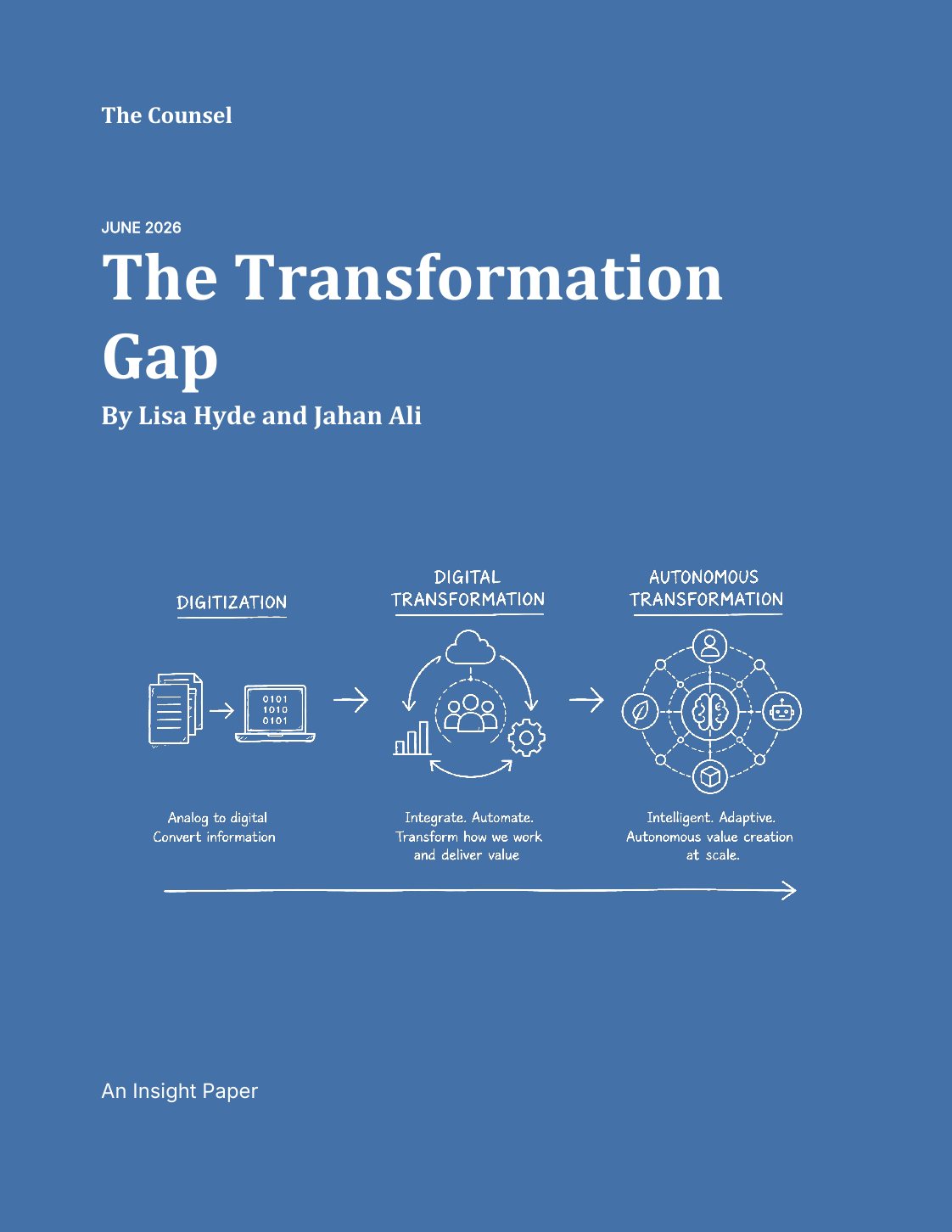
Organizations rarely fail at transformation because they lack projects. They fail because the ambition of the change exceeds the operating system around it. The paper identifies the nine human and cultural conditions and the four structural conditions leaders must address.
Lisa co-presented this session. The paper is the longer version of what she said on stage about resistance, sponsorship and the trade offs nobody names.
Open on hachiai.comNine deployments across industries, regions and systems. Every digital worker runs inside the systems the company already had. Each opens on hachiai.com.
Nine pieces that go deeper on the eight patterns. Each opens on hachiai.com.
The slides and the one-page playbook, plus a companion page, right away. We will email you the recording once ALL IN shares it with us.
The slides from the session, as presented.
NowEight patterns, eight best practices, eight questions to ask any vendor. One-page playbook, plus a companion page.
NowWe will email you the recording once ALL IN shares it with us.
Work email only, so the recording reaches you at your desk. HachiAI is ISO 27001 and ISO 42001 certified and GDPR and PIPEDA compliant.
Twelve questions, about four minutes. See your AI readiness score, a peer benchmark and three suggested use cases.
Where your volume is, what a mistake costs, whether the data is already digital and in one system, what the worker may touch and who approves, and what the return would be if that role ran itself.
See your AI readiness score, a peer benchmark and three suggested use cases.
If you want it, a call: you show us one high volume workflow that eats your team's time, we show a digital worker running that kind of work live inside a real system, and you leave with the scope and a realistic timeline. No obligation.
Back to all resources